By the French Revolution of 1789 fashion changes developing since 1775 took effect. The new female hair fashion was to wear a wig of arranged curling coils on top of the head letting the natural hair fall loosely down the nape of the neck.
As the 18th century came to a close, all things Roman were in fashion with cropped simple hairstyles. This was soon replaced by a vogue for all styles Greek and the simplicity of freshly washed hair copied from Greek vases was thought attractive.
Victorian Delicacy
Women in the 19th century liked to be thought of as fragile ladies. They compared themselves to delicate flowers and emphasised their delicacy and femininity. They aimed always to look pale and interesting. Paleness could be induced by drinking vinegar and avoiding fresh air. Sometimes ladies discreetly used a little rouge on the cheeks, but make-up was frowned upon in general especially during the 1870s when social etiquette became more rigid.
Actresses however were allowed to use make up and famous beauties such as Sarah Bernhardt and Lillie Langtry famous beauties of the 1880s could be powdered. Most cosmetic products available were still either chemically dubious, or found in the kitchen amid food colourings, berries and beetroot.
A pale skin was a mark of gentility. It meant that a lady could afford to not work outdoors getting suntanned which was then considered vulgar and coarse. Continuous work in sun and harsh weather coarsened the skin then, as it does now. Parasols were de rigueur and used to protect the complexion. Rooms were shuttered with dark heavy velvet curtains to keep out the sun's rays. Some effort was made keep the décolleté neckline in good condition as it was often exposed in evening dress. Fine blue lines would be painted on the skin to increase the appearance of delicate translucent skin showing veins.
During this time it was thought that a woman's crowning glory was her hair. It was rarely cut, usually only in severe illness. It was also supplemented by false hair depending on the current fashion.
After 1886, Harriet Hubbard Ayer promoted face creams and various anti-ageing products. Before that, little that was satisfactory had been available.
Edwardian Beauties
It often surprises people to learn that it was the dowagers and matrons of Edwardian high society who were also the fashion leaders of Edwardian society.
Many an Edwardian society hostess in middle age was in urgent need of the help of cosmetics and by 1900 face enamelling was once again beginning to be accepted among society ladies. The Edwardian society hostess's complexion, ravaged by age, a high carbohydrate diet, spasmodic exercise, combined with living in a dirty polluted atmosphere was far from radiant. Queen Alexandra flaunted her make-up and shocked and amused observers. But she epitomized the feminine ideal of the Naughty Nineties. Ladies were more discreet and despite a gradual acceptance of make-up in the 1890s, it was still considered 'not nice' to admit to its use.
The House of Cyclax
Ladies of society liked to preserve the myth of being naturally beautiful. A Mrs. Henning, who owned a beauty salon in South Molton Street, London, which later became the House of Cyclax, had a special back door for embarrassed clients. Heavily veiled, a lady would hurriedly alight from her carriage and disappear into the discreet entrance.
Initially Mrs. Henning sold creams plus three shades of rouge. Hostesses also used 'papier poudre' (still available from Avon and at some make up counters today). 'Papier poudre' came in books of colored paper and pressed against the cheeks or nose, the leaves of powder removed shine. Burnt matchsticks were used to darken eyelashes, and geranium and poppy petals stained the lips.
Helena Rubenstein Cosmetics
»
With such primitive cosmetics as these it was inevitable that those who could afford it would flock to Helena Rubenstein's salon when she opened in London.
'She did not have to wait for customers. They came veiled, and no lady carried money with her. But they were prepared to pay considerable sums.'
The sweet pea colour of the clothes was complemented by the lavender smells and until 1901 this was the only admissible perfume for hostesses. Lavender was associated with ladylike qualities. You can read more about perfume developments of the era in Perfumes.
The Marcel Wave
In her desire to appear natural many ladies had their hair waved. In 1908 Marcel of France introduced a new form of hair waving called the Marcel wave. At a stroke hairdressing techniques in Britain were revolutionized. This technique curled the hair with hot irons in a waved arrangement around the head. As well as Marcel waving, women also dyed their hair.
Nestle Permanent Hair Wave
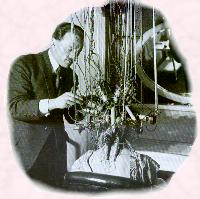 By 1906 Charles Nestle invented the permanent wave. An electric
heat machine was attached to the hair pads protecting the head and curled the
hair.
By 1906 Charles Nestle invented the permanent wave. An electric
heat machine was attached to the hair pads protecting the head and curled the
hair. Right - Picture of Charles Nestle using his electric machine to produce a Nestle waved hairstyle.
A Woman's Crowning Glory
Until the 1914 war, hair was always considered a woman’s crowning glory. Society ladies dressed it with jewels, feathers, elaborate combs, or an aigrette which was a combination hair ornament made up of all these things.
See hair and hats of the era here.
Selfridges
By 1909 Selfridges opened in London's Oxford Street and they openly sold cosmetics. Cosmetics displays were openly visible to the customers and were no longer hidden under the counter.
The Influence of Diaghilev's 'The Ballet Russe' and Poiret
Then in 1910 Sergei Diaghilev's Russian ballet became influential in fashion. Influenced by the styles of the ballet, Paul Poiret created designs based on the ballet costumes and these took London by storm. This had a definite influence on make-up and clothes. Ladies began to favour more exotic brighter coloured clothes and this was reflected in more vivid make up. Tattooing became especially popular among society ladies and many a society hostess had lips, pink blushes and dark eyebrows permanently needled in.

No comments:
Post a Comment